
Broken Dreams

A Restorer’s Journey Through Passion and Regret
Revised by John Lewis (January 19, 2025)

The first lie in any restoration isn’t in the classified ad. It’s the one you tell yourself.
I told mine in a dim suburban garage. The overhead bulb threw more shadow than light, catching the edge of a dented tank and a film of dust on dulled chrome. The bike—what was left of it—sat half-buried behind lawn chairs and Christmas decorations, the ghost of someone else’s dream.
Objectively, it was tired: scarred plastics, oxidized fasteners, cables hanging like cobwebs. But I didn’t see the years of neglect. I saw potential. I saw late-night test rides, perfect paint, polished metal, the quiet satisfaction of having brought something back from the brink. In that moment, I stopped being a buyer and became a restorer.
It felt like purpose. It also set me up for a long run of very expensive lessons.
Restoration is seductive because it promises more than a machine. It offers accomplishment, a channel for creative energy, a way to touch history with a wrench in your hand. It flatters your intelligence: you will decode wiring diagrams, track down obsolete parts, outthink problems that defeated previous owners. When it works, the payoff is undeniable. Riding a bike you rebuilt yourself is a rare kind of satisfaction—every fastener a small signature in metal.
But that is only half the story. The other half is sunk cost, late invoices, and evenings when the garage feels less like a workshop and more like a confessional. I have been through both.
The First Dream: Buying the Idea, Not the Bike
My first proper project was a Yamaha FZR600 advertised as a “light project.” The photos showed tired fairings and faded paint, but the lines were still there. An affordable way into a nineties sport bike with real pedigree—that was the story I sold myself on the drive over.
The reality was a track refugee. The FZR had done budget racing duty, and it showed. The subframe was slightly twisted. The wiring loom looked like three different people had been in there, none of them sober. The engine would start, but only with ritual and luck. What was pitched as a weekend tidy-up rapidly devolved into months of diagnosis and parts hunting.
The lesson arrived slowly, the way rust creeps along a frame: I hadn’t bought a motorcycle. I’d bought a collection of problems organized loosely around a VIN.
It’s easy to fall in love with the silhouette of a bike and ignore everything else. You project forward to the finished object and discount the cost of getting there: time, money, and attention—three things most adults have in finite supply. The honeymoon ends the first time you shear off a seized bolt that didn’t need to be touched in the first place.
Looking back, the FZR was less a project than a curriculum. It taught me the language of parts catalogues and the patience required to trace intermittent electrical faults that only appear after midnight. It also exposed a blind spot: the way optimism can masquerade as competence.
Lessons in Nostalgia: The Classic Trap
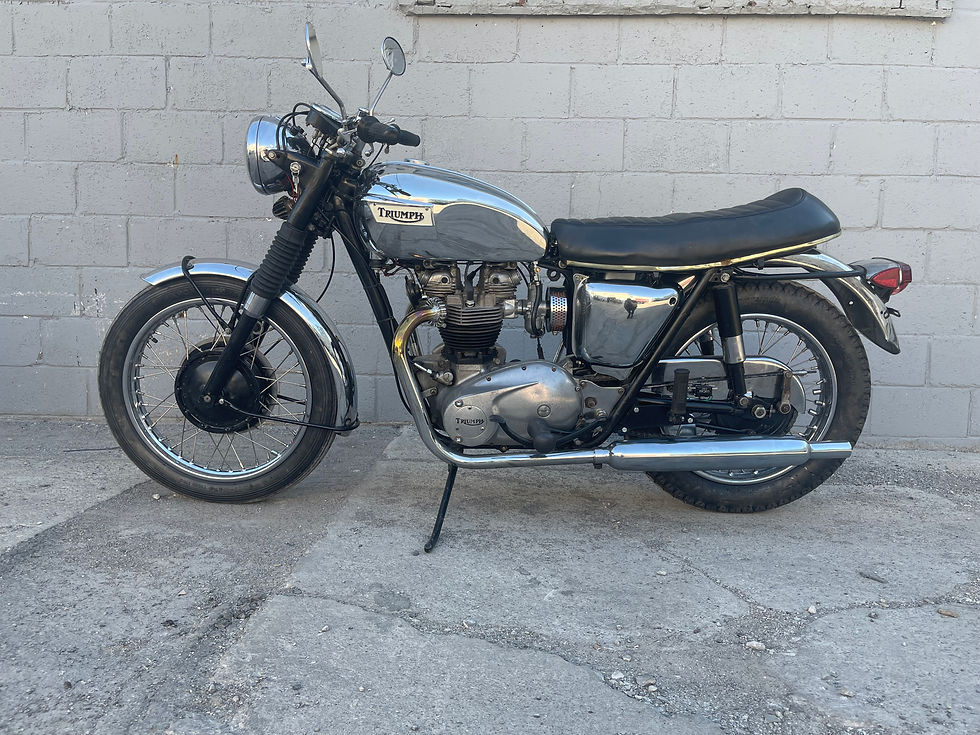
My next mistake was more dignified, and therefore more dangerous: a 1969 Triumph Tiger, discovered in a barn and pitched as “90% complete.”
To anyone drawn to classic machinery, that sentence is almost irresistible. Ninety per cent suggests proximity to completion. It hints that someone else has done the drudgery and that you will arrive in time for the satisfying final ten per cent.
In reality, the missing ten per cent of a vintage British motorcycle is usually the most expensive and least accessible. In my case it included Amal carburettors that were more corrosion than metal, rims that needed re-chroming rather than “a quick polish,” and an electrical system that bore only a passing resemblance to the factory diagram.
This was a different kind of entanglement. The FZR had been a functional problem: make this neglected race bike whole again. The Triumph was emotional. I wasn’t just rebuilding a machine; I was trying to conjure an era—the texture of mid-century engineering, the cadence of a parallel twin on a cool evening.
Nostalgia is a powerful fuel. It kept me in the garage when reason suggested I should walk away. It also distorted my judgement. I found myself hesitating over sensible upgrades: more capable brakes, electronic ignition, modern tyres. Rationally, these would make the bike safer and more usable. Emotionally, each deviation from stock felt like vandalism.
That tension—between authenticity and function—sits at the heart of many restorations. Purists chase factory correctness down to hose clamps and fastener finishes. Pragmatists quietly fit stainless hardware and modern electronics. I still haven’t resolved the conflict. Each project is an argument between the engineer in me and the archivist.
Custom Temptations: The Harley Sportster

Not every bike deserves preservation. Some invite reinvention.
When a tired Harley-Davidson Sportster came up at a price I couldn’t ignore, I saw a blank canvas for a stripped-down bobber—low, clean, and personal. Unlike the Triumph, there was no obligation to history here. The value lay in what the bike could become, not in what it had been.
Customization, I discovered, carries its own brand of scope creep. Change the exhaust and you’re into fuelling. Lower the rear and you discover you’ve just compromised cornering clearance. Swap bars and suddenly your cables and brake lines are the wrong length.
Each decision has second-order effects. Parts that look coherent on a mood board don’t always cooperate in three dimensions. What begins as a simple plan to “tidy things up” becomes a long chain of dependent choices—all of them drawing against the same accounts of time and money.
And yet, when the Sportster finally fired and settled into its uneven idle, with the stance and silhouette I’d imagined months earlier, it was hard not to feel that the irrationality had been justified. A custom build connects to its owner differently. You are not merely maintaining someone else’s idea; you are living with your own.
The Emotional Ledger
It’s easy to discuss restoration in terms of parts and hours. The more honest ledger is emotional.
There is the guilt of opportunity cost: money diverted from family priorities, evenings claimed by the garage instead of the people who live upstairs. There is the hit to your confidence when an apparently simple task goes sideways and takes a thread, a component, or a week with it. There is the quiet isolation of working alone late into the night, convincing yourself that one more adjustment will fix it.
At my lowest, I caught myself avoiding the garage entirely. Walking past a covered, unfinished project can feel like passing an unresolved argument. You know that going back in means confronting your own earlier decisions—the shortcuts, the overreach, the parts bought impulsively and now gathering dust.
What kept me from abandoning the whole enterprise wasn’t romantic grit. It was structure: making lists, setting modest, defined goals, budgeting realistically rather than optimistically. And it was community.
Online forums and local clubs are easy to dismiss until you need them. Somewhere out there is someone who has wrestled with the exact seized spindle or obscure bracket that currently has you stuck. Their photographs, notes, and after-the-fact wisdom can save you hundreds of dollars and hours of frustration. More importantly, they remind you that the struggle is normal, not a personal failing.
Why We Keep Doing It
For all the aggravation, there is still that moment.
The first start after a full teardown is not dramatic in any cinematic way. It is usually awkward: fuel taps double-checked, extinguisher nearby, one hand hovering over the kill switch. The starter turns. The engine coughs, then catches. The noise is louder and rougher than you’d forgotten, and for a few seconds you hear only variations in pitch and rhythm, scanning for problems.
When the idle finally stabilizes, something in you does the same.
No dealer delivery can replicate that feeling. You know, in granular detail, what is happening inside the machine. You’ve handled the bearings, torqued the fasteners, set the clearances. When you noise-test the exhaust or check for leaks, you are not inspecting a product; you are evaluating your own work.
The first proper ride is less revelation than confirmation. Brakes bed in, cables stretch, and small noises announce themselves that only you will hear. You make notes and adjust. Over the next few weeks a new equilibrium emerges between you and the bike—a negotiated understanding of its limits and personality.
This intimacy is the real output of restoration. The paint and polish can be bought. The relationship cannot.
Restoring the Operator
In hindsight, the bikes were never the only projects.
Each build forced a confrontation with my own habits and assumptions: my aversion to asking for help, my tendency to underestimate complexity, my inclination to treat time as an elastic resource that could be stretched indefinitely. Under the fluorescent lights of a cold garage, those tendencies are hard to ignore.
Restoration, done honestly, demands that you develop systems: how you organize parts, track tasks, and make decisions about when to repair, replace, or walk away. Those same disciplines bleed outward into the rest of life. You become more realistic about what you can take on, more sceptical of vague optimism—your own and others’.
For professionals whose days are spent in abstractions—contracts, models, strategies—there is something grounding about working on a motorcycle. The feedback is immediate and indifferent to status. Either the engine runs or it doesn’t. Either the wheel bearings are correctly preloaded or they are not. Reality has teeth, and it bites without ceremony.
That is, ultimately, why I keep coming back to it. Restoration is a controlled environment in which failure is instructive rather than catastrophic. Every seized fastener, every mis-ordered part, every late-night breakthrough is a small reminder that competence is earned, not assumed.
You may start out trying to resurrect a machine. If you stay with it long enough, you end up renovating your own tolerance for frustration, your standards for work, and your capacity to see a difficult thing through.
In the end, the bike is new again, or as new as it can reasonably be. More importantly, you emerge with a clearer sense of your own limits and your own resilience. The road ahead is the same, but you meet it differently—on a machine you now understand, with evidence in the frame and in yourself that, given enough patience and a little grease, broken things can be made to work again.
Suggested Reading and Bibliography
Bridge, J. The Motorcycle Restoration Handbook. Motorbooks International, 2014.
Lichter, M. The Art of the Custom Motorcycle. Motorbooks, 2009.
Morgan, D. The New Motorcycle Restoration Handbook. MBI, 2005.
Walker, M. Classic Motorcycle Restoration and Maintenance. Haynes Publishing, 2006.
“FZR600 Community and Vintage Sportbike Forums.” Accessed January 19, 2025. https://www.fzrarchives.com
“Triumph Rat Motorcycle Forums.” Accessed January 19, 2025. https://www.triumphrat.net
“Harley-Davidson Forums.” Accessed January 19, 2025. https://www.hdforums.com
“Clymer Repair Manuals.” Accessed January 19, 2025. https://www.clymer.com
These sources offer practical guidance on everything from vintage British twins to customizing American V-twins. They combine step-by-step procedures with model-specific quirks, and their forums connect you to practitioners who have already made—and documented—the mistakes you are trying to avoid.


Comments